1968: The Year That Rocked the World by Mark Kurlansky
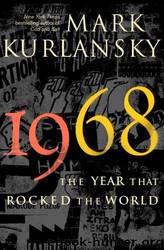
Author:Mark Kurlansky [Kurlansky, Mark]
Language: eng
Format: epub
Tags: History, General, Modern, 20th Century, Fiction
ISBN: 9780345471918
Google: ZXSnvkSIbQsC
Amazon: B000FC0XWI
Publisher: Ballantine Books
Published: 2003-12-29T16:00:00+00:00
CHAPTER 12
MONSIEUR, WE THINK
YOU ARE ROTTEN
A man is not either stupid or intelligent, he is either free or not free.
—Written on a wall of the Faculté de Médecine,Paris, May 1968
To be free in 1968 is to take part.
—On a stairwell in the school of Science Politique,Paris, May 1968
Certain French students, having found out that students in other countries have shaken up and smashed everything, want to do the same.
—ALAIN PEYREFITTE, French minister of education,explaining events, May 4, 1968
AS SPRING CAME to rainy Paris, France’s leader, the seventy-eight-year-old general, a man of the nineteenth century, with his near absolute power, ruling under the constitution he had written himself ten years earlier, promised stability, and delivered it.
The not quite octogenarian, not quite king, entertained fantasies of monarchy, in fact invited the pretender to the French throne, Henri Comte de Paris, to his palace for talks from time to time—the bethroned president with no crown playing host to the king with no throne. While de Gaulle had little tolerance for opposition, he acted as though he had moved beyond politics and its constant search for supporters to a kind of inevitable permanence. In 1966, ensconced in his palace’s regal Salles des Fêtes, he was asked about his health and answered, “It is quite good—but don’t worry, I shall die sometime.”
On March 15, 1968, while Germany, Italy, Spain, the United States, and much of the world was exploding, Le Monde journalist Pierre Viansson-Ponté wrote a now famous editorial in which he said, “France is bored.” Around this same time, de Gaulle was smugly declaring, “France is in a satisfactory situation, whereas the Germans are having their political difficulties, the Belgians their language problems, and the British their financial and economic crisis.” He continually emphasized that the French should be pleased with this dull peace that he had given them.
While de Gaulle infuriated the rest of the world, a poll released in early March by the conservative French newspaper Le Figaro showed that 61 percent of the French approved of his foreign policy, whereas only 13 percent disapproved. Of course, disapproving of de Gaulle could be complicated in France, as François Fontievielle-Alquier, a respected journalist, found out when he was brought to court in March 1968 on an eighty-seven-year-old law against criticizing the president. Prosecutors cited twelve passages in his new book, Re-Learn Disrespect, that fell under “attacks on the honor” of the head of state. The law passed on July 29, 1881, provided for prison sentences up to three years or fines from 100 to 300,000 francs ($20 to $60,000 at 1968 exchange rates) for “offenses” in the form of “speeches, shouts, threats uttered in public places, writings, articles in the press.”
This was the three-hundredth time the law had been invoked since de Gaulle became president. In one case a man was fined 500 francs for shouting, “Retire!” as de Gaulle’s car passed.
If the French said they were pleased with de Gaulle’s foreign policy, almost no one else was. His peculiar brand of nationalism seemed to threaten most international organizations.
Download
This site does not store any files on its server. We only index and link to content provided by other sites. Please contact the content providers to delete copyright contents if any and email us, we'll remove relevant links or contents immediately.
| Canada | Caribbean & West Indies |
| Central America | Greenland |
| Mexico | Native American |
| South America | United States |
Cat's cradle by Kurt Vonnegut(15363)
Pimp by Iceberg Slim(14520)
4 3 2 1: A Novel by Paul Auster(12401)
Underground: A Human History of the Worlds Beneath Our Feet by Will Hunt(12101)
The Radium Girls by Kate Moore(12035)
Wiseguy by Nicholas Pileggi(5793)
The Fire Next Time by James Baldwin(5454)
Perfect Rhythm by Jae(5410)
American History Stories, Volume III (Yesterday's Classics) by Pratt Mara L(5312)
Paper Towns by Green John(5195)
Pale Blue Dot by Carl Sagan(5013)
A Higher Loyalty: Truth, Lies, and Leadership by James Comey(4966)
The Mayflower and the Pilgrims' New World by Nathaniel Philbrick(4508)
The Doomsday Machine by Daniel Ellsberg(4493)
Killers of the Flower Moon: The Osage Murders and the Birth of the FBI by David Grann(4451)
The Sympathizer by Viet Thanh Nguyen(4398)
Too Much and Not the Mood by Durga Chew-Bose(4352)
The Borden Murders by Sarah Miller(4330)
Sticky Fingers by Joe Hagan(4205)
